The Sound of Music in Primary: Discovering the Montessori Bells at TMSOE
Music is a vital form of language and expression. At The Montessori School of Englewood, we believe that just as children are capable of effortlessly absorbing spoken language, they are equally capable of—and deserve the opportunity to—express themselves musically.
In our Primary (Head Start partnership and Pre-K) classrooms, we cultivate an environment where children are not just consumers of music, but creators. A cornerstone of this musical exploration is a beautifully constructed material: The Montessori Bells.
To the adult eye, the Bells may look like a collection of objects on a table. But to the children in our community, they are a direct invitation into the intricate and joyful world of music.
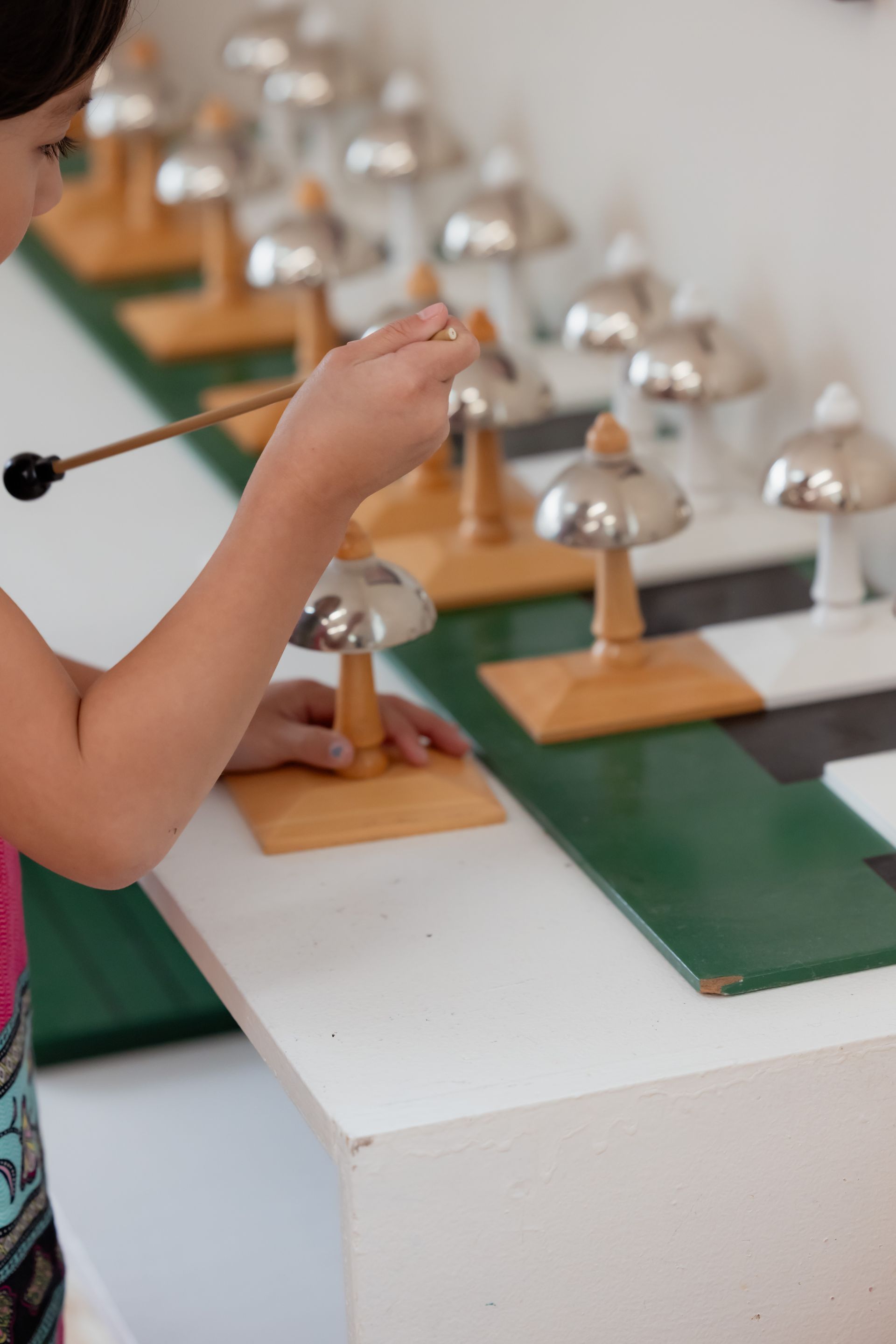
Each individual bell is perfectly tuned, designed to deliver a distinct, pure tone when gently played with a specific mallet. They help our young learners develop a precise ear for pitch and tone, encouraging a genuine appreciation for musical instruments and the limitless potential of human expression.
Creating Access to Sound: The Set-Up
Following our belief in the child’s capability and independence, the Montessori Bells are easily accessible in our Primary classrooms. They are arranged on specially designed tables—scaled to the child's size—and organized strictly according to their pitch.
The complete material consists of two sets of 13 bells, representing the full chromatic scale starting from Middle C.
- The Control Set (Black & White stands): This set is placed toward the back of the table and serves as the absolute reference point. These are arranged precisely like a piano keyboard, where the white bells represent whole notes, and the black bells are the sharps and flats.
- The Working Set (Brown stands): The other set of bells, on natural, varnished wood stands (often called the "brown bells"), is paired with its control counterpart.
Additionally, the bells rest on boards that serve as visual guides, mimicking the pattern of black and white keys on a piano. This careful organization—matching the visual, tactile, and auditory experience—builds a strong foundation for abstract musical understanding.
Grounded in Respect: Playing the First Bell
The Montessori approach recognizes that "freedom requires discipline." Before children begin playing the bells, they must first build foundational skills in self-control and care. In our TMSOE classrooms, children gain significant experience caring for materials and refining their visual and auditory senses (using materials like our sound cylinders) before the guide introduces the Bells.
We show the children how to play a single bell with a meticulous, respectful, and joyful process. This multi-part lesson is essential in honoring the delicate nature of the instrument and the intentionality of the work:
- Carrying: How to carefully move the bell from the set to the workspace.
- Striking: Using the mallet to gently and with precision create a pure tone.
- Listening: Appreciating the sound and allowing it to completely fill the space until it naturally fades.
- Damping: Learning how to use a damper to stop the tone completely.
- Returning: Most importantly, how to return the brown bell to its exact, proper location within the set.
Returning the bell properly is a sophisticated lesson. We model for the child how to carefully check that the tone of the brown (working) bell perfectly matches the tone of the white or black (control) bell behind it.
This experience helps the child focus deeply on a singular musical concept: The two bells look different (or, in later stages, look the same), but their sound is identical.
The Challenge of Harmony: Pairing the Scales
As children demonstrate mastery and focus with this initial work, the Guide introduces the next challenge: Pairing.
The experience begins with the adult modeling the full scale, showing the children that the bells exist in a particular order. We might play "up" the working set (ascending) and "down" the control set (descending), allowing the child to hear the natural gradation and experience the powerful impression of the C Major scale.
Next, the adult models "breaking" that order. We might remove four bells from the set, deliberately mix them, and move them to a different space.
Then begins the internal process of reconstruction. We model for the child how to problem-solve, drawing on the skills they have already learned: "We already know how to match the working bell to the control bell. We will use that same technique now."
Working from left to right, we move one mixed-up working bell to the first empty control space. We play the control (back) bell, and then the working (front) bell.
- If they sound the same: The bell has found its home. We place it on its board.
- If they sound different: We slide the working bell to the right, to the next control space, and repeat.
Once all the bells are paired, we again play "up" and "down" the scale to confirm everything is in its correct order. When modeling is complete, we invite the child to attempt the pairing process themselves. We start with a manageable number of bells (four) and stay nearby to offer support or to fade into the background as their confidence and success grow.
This is a deep lesson in focus, auditory discrimination, and systematic thought.
A Language of Their Own: Writing and Reading Music
Once a child has successfully paired and graded the full diatonic scale (whole notes), we are ready to introduce the next profound step: the "writing and reading" component of music.
In the same way that children explore language—first through the spoken word, then through the symbols of letters (using our moveable alphabet)—they explore music. Composers have melodies in their heads and they "write" them using the notes of the staff.
We use beautiful, large staff boards and small, wooden circles to represent notes. The children learn the symbols and names for the pitches and how to physically place them on the staff. They are encouraged to eventually even "write" their own melodies, exploring music as a language that is deeply personal and expressive. Like with spoken language, children first explore through writing, and later, begin to read existing melodies.
Rooted in Equity, Expressed in Song
At TMSOE, we believe in bringing Montessori back to its roots: breaking down barriers to access and honoring the whole child. We teach the whole child—heads, hands, and hearts.
By providing our children with the time, space, and materials to deeply engage with music, we affirm their identity as capable, creative beings. We foster a peaceful community where their unique voices—spoken and musical—are heard and valued. Musical expression is not a privilege at TMSOE; it is an essential thread woven into the fabric of our children's education.
To experience this sense of harmony, focus, and joy for yourself, we invite you to
schedule a tour of our classrooms. We welcome you to join our TMSOE community.