The Globe That Opens the World: How Montessori Geography Ignites Imagination
In seeking to understand the world, young children ask so many questions! The Montessori geography materials meet that curiosity with simple, beautiful objects that help children put the world into context.
As Dr. Montessori explains in Education for a New World, "Children are not able to follow long explanations, and need simple answers, where possible helped by some illustrative object, such as the globe to the child's quest in geography."
So our geography materials offer illustrative objects, such as a globe, puzzle maps, and trays of land and water forms. The results of offering children these real objects are often quietly extraordinary.
Real Things to Imagine
Dr. Montessori observed that young children have a remarkable and largely untapped capacity for imagination, but this capacity is often channeled in a limited way. As she wrote, "This strength of imagination in the child under six is usually expended on toys and fairy tales, but surely we can give him real things to imagine about, so putting him in more accurate relation with his environment."
Certainly, the study of geography provides the young child with tremendous opportunities to mentally explore seemingly new worlds: places full of different animals, homes, people, and landscapes unlike anything in their immediate experience.
Dr. Montessori shared a charming story that captures the Montessori approach to geography. A group of six-year-olds was gathered around a globe when a child not yet four years old ran up to see. Looking at the model of the earth, the little one suddenly understood something: "Is this the world? Now I understand how it is my uncle has gone three times round the world.” In that moment, the child could understand that the globe was only a model and that the real world was immense. In a single interaction with one simple material, a young child had made a conceptual leap from the concrete object in front of them to the vast reality it represented.
A Mind That Goes Beyond the Concrete
Young children are often underestimated in their capacity for abstract thought. Because they learn through their senses and their hands, we sometimes assume they can only grasp what is directly in front of them. Dr. Montessori pushed back on this firmly: "Is the child's mental horizon limited to what he sees? No. He has a type of mind that goes beyond the concrete. He has the great power of imagination."
The child who can imagine a fairy and a fairyland, as Dr. Montessori noted, has no difficulty imagining South America, or a distant mountain range, or a culture on the other side of the earth. What they need is something real and beautiful to anchor that imagination. The geography materials allow children to imagine aspects of the Earth and its features that they might not otherwise see or access. They can experience the land and water forms and learn the vocabulary of strait, isthmus, and peninsula. They can differentiate between the continents and begin to explore the rich differences of human cultures.
Learning Through the Hands
Like all Montessori materials, the geography materials for children ages three to six are designed to be touched, handled, and explored. As Dr. Montessori explains, "the child's mind can acquire culture at a much earlier age than is generally supposed, but his way of taking in knowledge is by certain kinds of activity which involve movement."
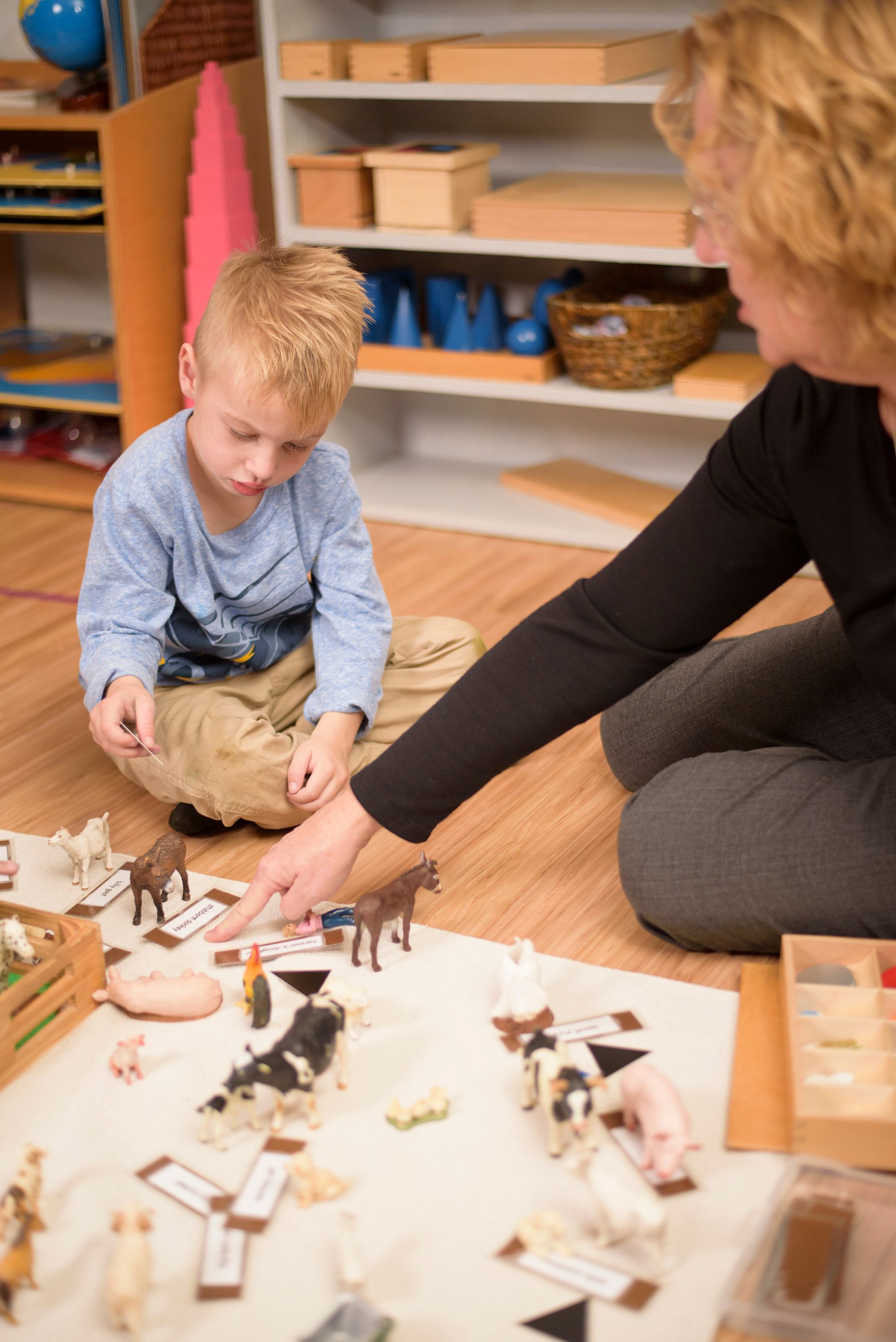
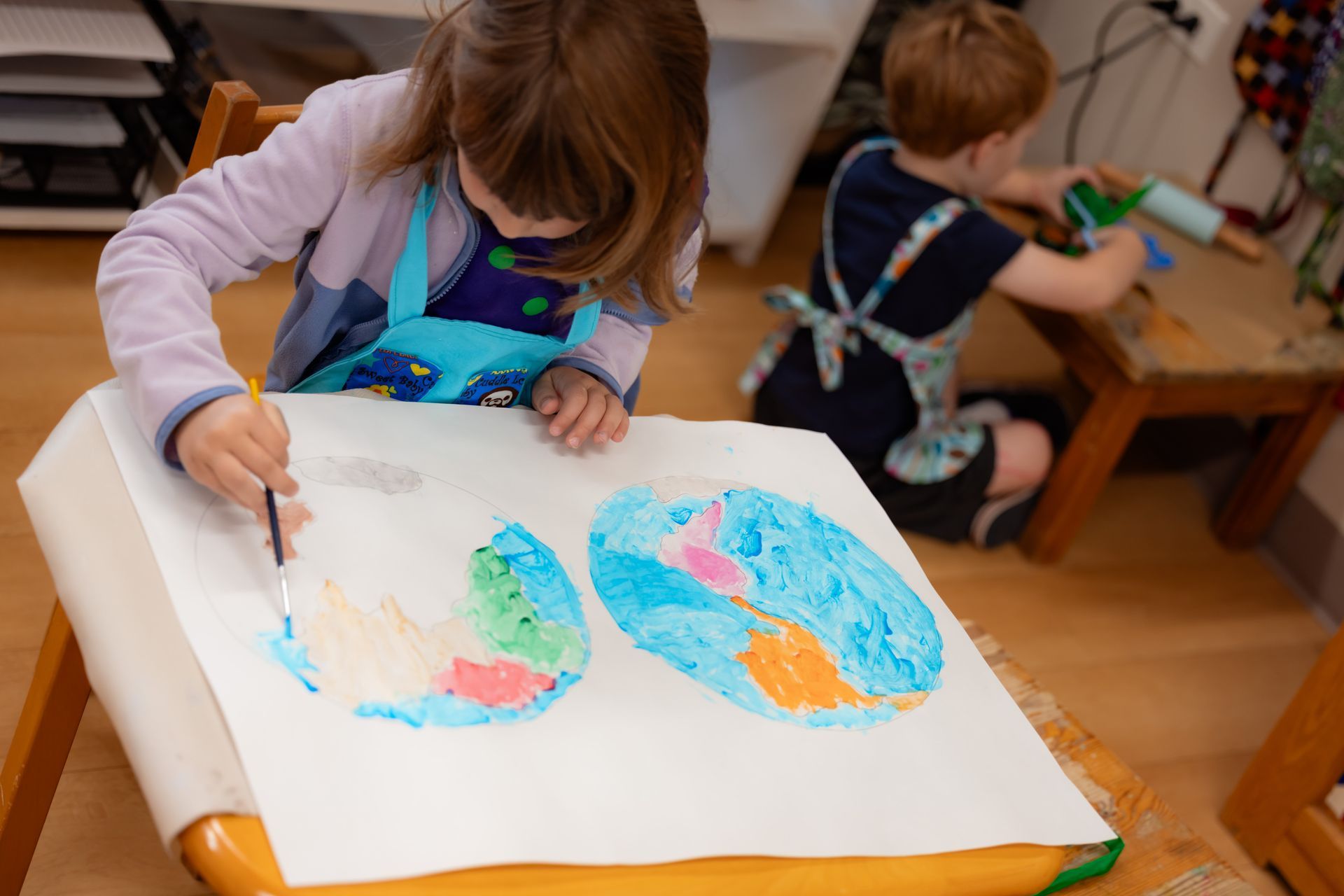
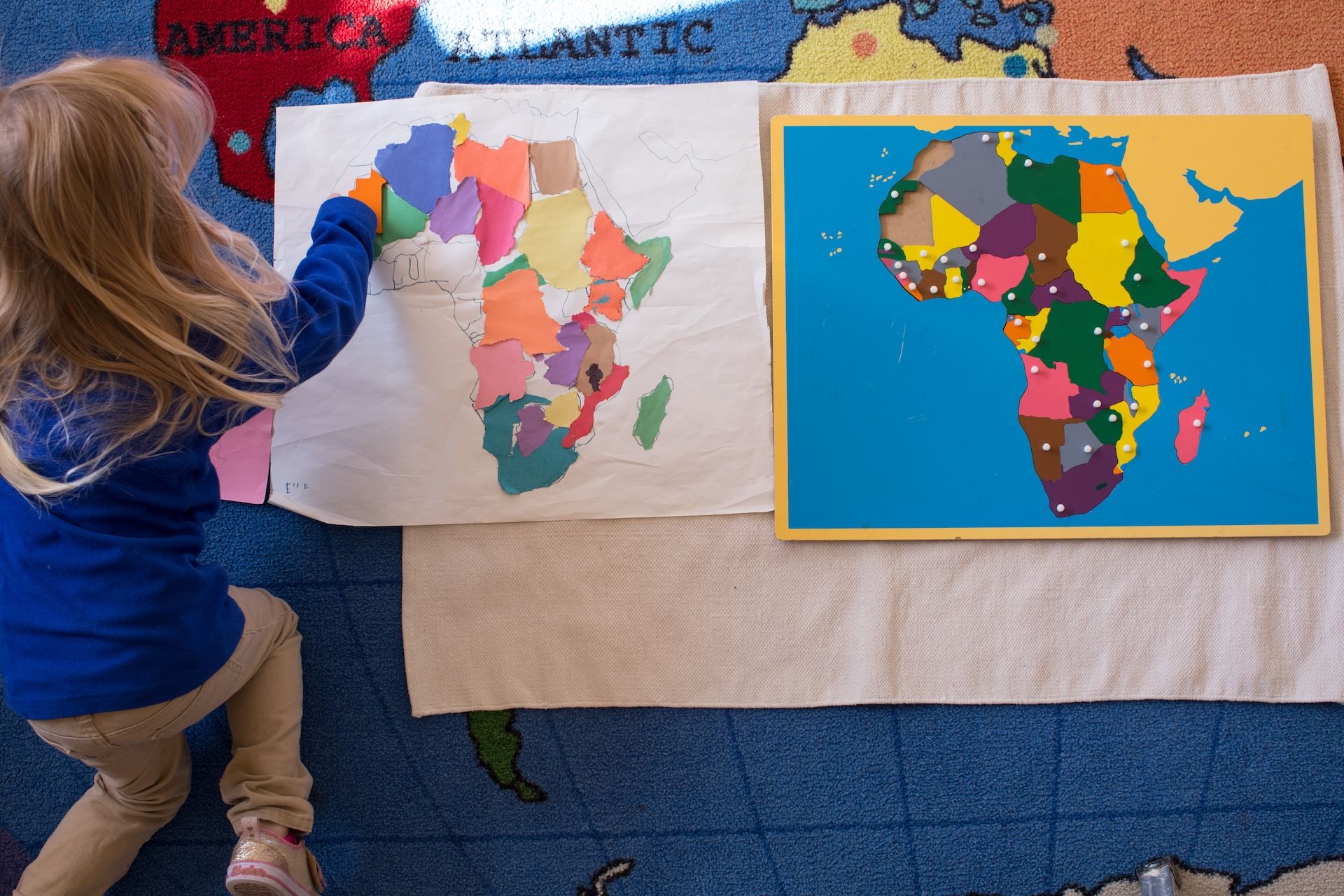
The land-and-water globe invites children to run their fingers across rough land and smooth water, building a sensory impression of the earth's surface that extends beyond a two-dimensional photo. The land and water forms allow children to pour water into trays with pre-shaped landforms, so they can experientially discover the physical differences between a peninsula and an isthmus, a cape and a bay. The puzzle maps offer children a satisfying, hands-on experience of lifting, rotating, and placing wooden continent pieces, and even distinguishing between countries and states. Children touch the shapes of the continents with their fingertips and name them as their own.
Through all of this, children are doing what Dr. Montessori consistently described as their natural mode of learning: using their hands to access new information, and then using that grounding in reality to conceptualize aspects of the world through the power of imagination.
Curiosity as a Compass
One of the more significant outcomes of Montessori geography work is how it awakens and deepens children’s curiosity. As Dr. Montessori wrote, "When a child's interest is aroused on the basis of reality, the desire to know more on the subject is born at the same time." The early childhood geography materials are designed to open a door so as to make the world feel knowable, fascinating, and worth exploring.
The continent boxes, the cultural photographs, the land and water forms — all of it plants seeds that will bloom into the rich, research-driven, globally aware work of the Montessori elementary curriculum, where children explore the history of civilizations, the geography of ecosystems, and the deep interconnection of all life on earth.
What Families Can Do at Home
The spirit of Montessori geography extends naturally into family life. A globe at home, pulled out whenever mentioning a faraway place in conversation, does far more than a map on the wall. Photographs from different countries, looked at together with a child and accompanied by genuine curiosity and conversation, open the same doors as the continent packets in the classroom. When something happens in another part of the world, and a child is nearby, finding it on the globe together — even for a moment — plants a seed of geographical awareness.
The principle behind all of it is one Dr. Montessori returned to throughout her work: give children real things to wonder about. Trust their minds. Point them toward the vast, varied world. It’s worth exploring endlessly!
We'd love for you to visit our classroom and see the geography materials in action. Schedule a tour here in West Englewood, Chicago, and watch what happens when a child first encounters the globe.