Montessori Materials Explained: Multiplication & Division Bead Boards
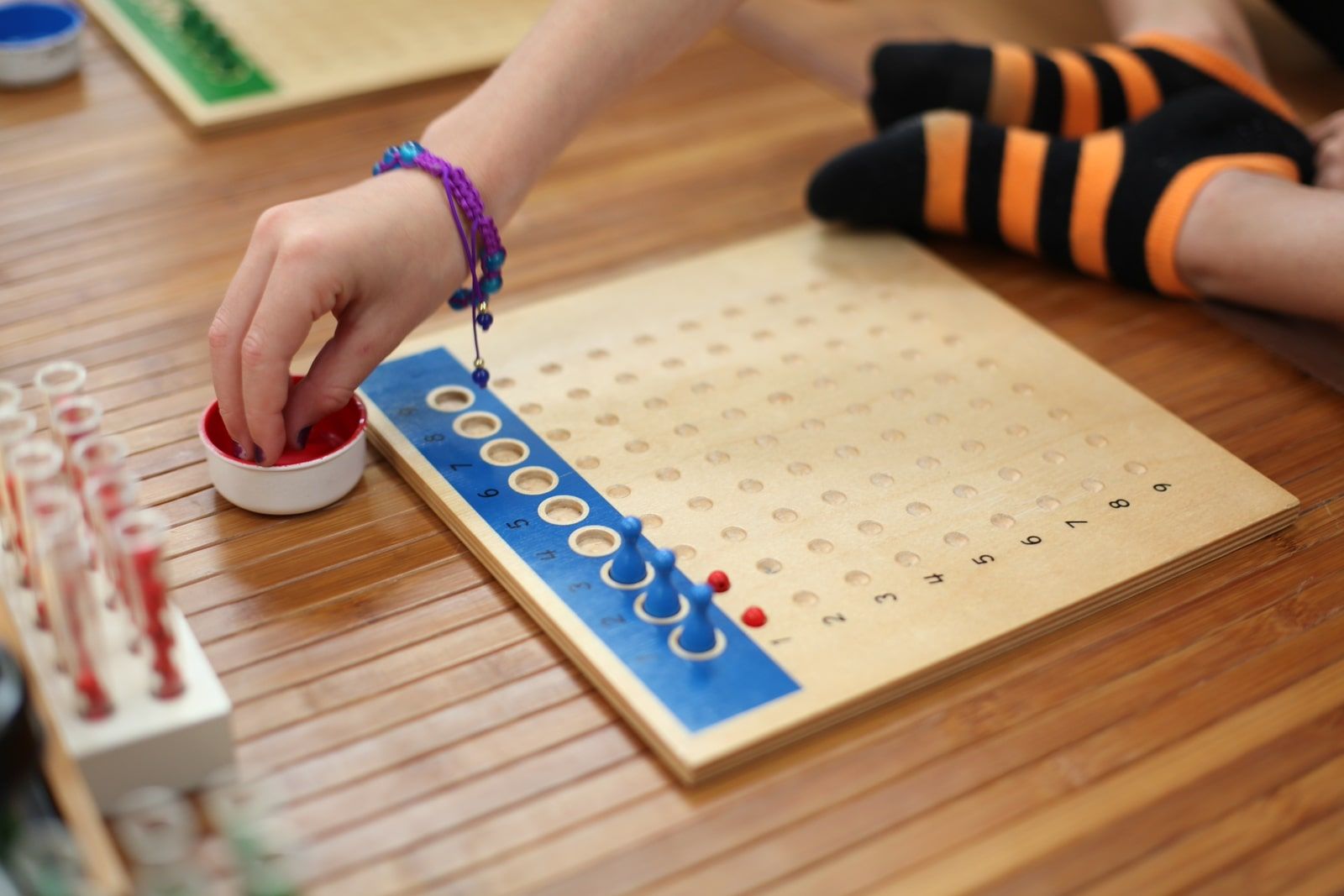
For many children, learning the multiplication tables (and their flip-sided partners, division facts) can feel like a tedious rite of passage. However, in Montessori classrooms, we approach math facts in a concrete, hands-on manner that makes the process both engaging and memorable.
Key tools in this process are the multiplication and division bead boards.
The Multiplication Bead Board
This simple wooden board, with its rows of little indentations and bright red beads, allows children to see multiplication patterns and feel the quantities of a number a certain amount of times.
The top of the board features the numerals 1 through 10, which represent the multiplier. A small card slot shows the multiplicand (the number being multiplied). Children move a red marker disk across the top to indicate the multiplier and then carefully count out beads into the columns below.
For example, if the multiplicand is five:
- With the marker over “1,” children place five beads, counting aloud: “Five, one time is five.”
- When they move the marker to “2,” children place another five beads and count again: “Five, two times is ten.”
- With each step, children build the product: bead by bead and column by column.
The process is slow, deliberate, and deeply satisfying. Rather than focusing on memorizing facts, children are able to internalize the structure of multiplication. Soon, they begin to notice patterns (for example, 5x3 makes a rectangle that looks like a 3x5 rectangle flipped on its side), skip-count naturally, and recall products with ease.
This material bridges the concrete and the abstract. Eventually, children record their work in multiplication booklets and then check against a control chart. Through this repetition, math facts transition from hands-on practice to memory, without the pressure or rote drilling that can often frustrate young learners.
Dr. Montessori herself remarked on how children loved this material. She noted that multiplication—something traditionally dreaded—became so enticing that children even asked to take the bead board home!
We often introduce the Multiplication Bead Board around ages five to six, when children are eager to explore patterns in numbers. It provides both a strong foundation for future abstract math, not to mention the joy of discovery that comes when math becomes something tangible and meaningful!
The Unit Division Board
When approached abstractly, division can be a tricky math concept for children to grasp. Unlike addition or multiplication, where patterns are more predictable, division often results in remainders, creating an unpredictability that can be frustrating when only approached abstractly.
In Montessori classrooms, we use the Unit Division Board to provide a more concrete, hands-on way to explore and internalize the process.
This material resembles the Multiplication Bead Board, but with one important difference: along the top of the board, there are indentations for small green peg-like figures (called “skittles”) that look like simplified versions of little people and that represent the divisor. The dividend (the total number to be divided) is shown with green beads, which children carefully distribute across the board. Along the left side are the numerals 1 to 9, showing the quotient.
For example, if the dividend is 18:
- With nine skittles across the top, children share out the 18 beads equally. The answer in division is what one gets, so one of the “skittle people” gets two beads (showing that 18 ÷ 9 = 2).
- If the divisor changes to six skittles, the same 18 beads can be shared among the three “skittle people,” showing that each one got three beads (18 ÷ 6 = 3).
- If divided by four, children will discover that some beads can’t be shared equally. These extra beads—the remainders—become an important part of understanding how division really works.
Through repeated practice with different dividends and divisors, children begin to notice which numbers divide evenly, which don’t, and how multiplication and division are related.
Dr. Montessori emphasized that division is different from the other operations because it reveals limits, remainders, and exceptions. The Unit Division Board makes those discoveries visible. Children see, with their own eyes and hands, that not every number can be divided evenly, an important truth about how numbers behave. The Unit Division Board invites children into that discovery process.
What could feel discouraging instead becomes an exploration, as well as an opportunity to discover patterns, and build a relationship with math that is based on confidence and joy!
We invite you to visit our classrooms here in Chicago, IL, to see how children in Montessori build a positive relationship with math!